The Role of Props, Set Dressing and Visual Styling in Creating Realistic…
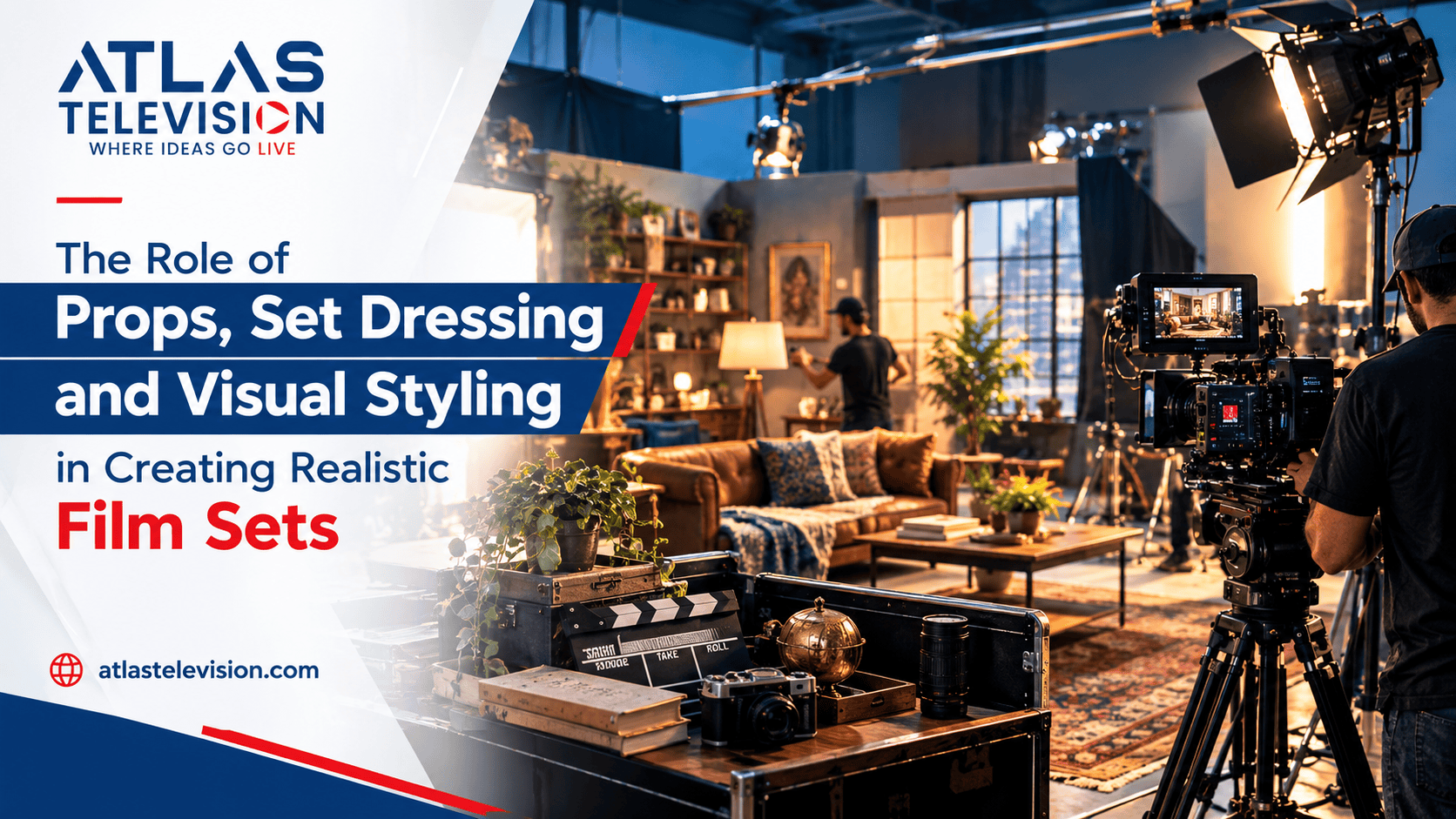
Most viewers never think about the lamp in the background or the abandoned meal on a table. But the people who placed those things there thought about almost nothing else for days.
Props, set dressing, and visual styling are where a film set becomes a believable place. They are the difference between an empty room with lights and a world an audience accepts without question. On professional productions, these elements do not just fill space. They communicate character, establish time and place, and create the visual consistency that makes a film feel like a single coherent experience.
The line between props and set dressing is practical, not philosophical. A prop is an object an actor physically handles during a scene: a phone they pick up, a glass they drink from, a document they sign. Set dressing covers everything else in the environment. It includes the furniture, the art on the walls, the books on shelves, the objects that define a space without ever being touched.
These two departments work in close coordination on professional productions. A book sitting on a shelf is set dressing. The moment an actor picks it up, it becomes a prop. The art department plans for these intersections in advance, because an unplanned interaction creates continuity problems between takes.
Understanding this distinction matters for production planning. Both categories need the same level of visual attention. The camera does not distinguish between what an actor touches and what sits two feet behind them.
By the time a set gets built or a location gets dressed, the key visual decisions are already made. This pre-production work establishes the look and feel of a production, and it happens through mood boards and visual briefs.
A mood board is not decoration for a production meeting. It is a practical communication tool. It shows the director, cinematographer, and production team what the visual world of the project looks like before a single item gets sourced or built. It covers colour palettes, textural references, lighting direction, period detail, and the overall atmosphere the art department is working toward.
Visual briefs then translate mood into specific decisions: which textures appear in the background, what the dominant colour range will be in a given scene, how the environment should reflect the character who inhabits it. This is where the Atlas Television art department, led by art director Tabriaz Haroon, begins its work. The team develops original concepts that define the visual identity of a production before any physical work starts.
A prop selected with care does two things simultaneously. It makes the environment feel real, and it tells the audience something specific about a character without dialogue.
Consider a desk in a law firm. Props that include current files, a specific pen, and a framed photo at a particular angle communicate occupation, order, and personal history in a single frame. Replace those with generic office supplies, and the scene loses specificity. The space becomes a set that looks like an office rather than somewhere a real person works.
This is the distinction between prop selection done well and prop selection done quickly. The first produces environments an audience reads as real without being able to explain why. The second produces sets that feel staged, even when everything is technically in place.
Sourcing the right props requires research into the period, cultural context, and character logic of the production. The Atlas Television art department handles prop selection and sourcing as part of its complete visual service, matching every object to the creative direction established in pre-production.
Several specific techniques allow set dressing to create environments that feel inhabited rather than arranged.
Colour is the most immediate. The palette of a dressed set directly affects the mood of the scene and how lighting interacts with the environment. The art department works closely with the director of photography to ensure dressing choices and lighting direction reinforce each other rather than compete.
Texture is the second major tool. A smooth wall and a rough one read as entirely different environments at similar colour values. Worn surfaces suggest history. Clean surfaces suggest control. The texture of every visible object contributes to a story the audience absorbs without consciously processing it.
Layering is the third technique. Professional set dressers add objects in layers: large furniture first, then mid-scale objects, then small personal details. This creates depth and makes spaces feel inhabited rather than staged. An empty corner becomes a credible environment when it contains a chair, a side table, a stack of books, and a lamp at the right height.
Continuity management runs through all of this. Once the art department dresses and locks a set, the position, condition, and arrangement of every item must stay consistent across multiple shooting days. The team monitors this through photography and design oversight on set, so nothing shifts between a shot on Monday and its matching cutaway filmed on Thursday.
Visual storytelling through production design does not happen in isolation. The art department works in direct coordination with the director of photography, the lighting team, and wardrobe throughout pre-production and on set.
Lighting and set dressing depend on each other more than most viewers realise. A set dressed with highly reflective surfaces behaves completely differently under the same lighting setup as one dressed with matte textures. The colour temperature of a practical lamp chosen as set dressing affects the colour balance of the shot. Any window the crew treats as a light source needs dressing to match.
Wardrobe adds a third dimension to this. If a character’s costume contains strong colour or pattern, the set dressing behind them needs to account for it. A busy background and a busy costume compete for attention in the frame. A considered background makes the character read clearly on screen.
Atlas Television builds this collaboration directly into its approach, with the art department aligning with lighting, DOP, wardrobe, and direction throughout the production. This coordination is what allows every visual element to function as part of a unified whole.
Getting the set dressed before the shoot begins is only part of the job. Maintaining visual consistency during production is where many shoots lose discipline.
Sets change during filming. Actors move things. Items shift between takes. Lighting adjustments require dressing changes. Scenes filmed out of sequence need to match scenes shot weeks earlier. Without dedicated design oversight on set, small differences accumulate into continuity errors that appear in the edit.
Professional art departments assign on-set supervision to catch and correct these changes before the camera rolls. Atlas Television provides this oversight as a core part of its service, staying on set during prep and shooting to ensure the visual brief appears in the frame. Their involvement continues into post-production, supporting the edit and grade to maintain visual tone through to the final cut.
The principles of props, set dressing, and visual styling apply across formats, but the specific demands change with each one.
For commercials, art departments keep visual styling tight and condensed. The environment needs to communicate a brand’s world quickly in limited screen time. Every object and texture carries proportionally more weight than it would in a feature film.
For narrative films and television productions, set dressing needs to sustain believability across many scenes and locations. Continuity becomes more complex, and the relationship between set dressing and character development deepens over time.
For music videos, visual styling often prioritises aesthetic impact over strict realism. The environment becomes part of the artistic expression rather than a neutral backdrop.
The Atlas Television art department works across all of these formats, supporting commercials, films, TV shows, and music videos produced in Dubai and across the UAE and GCC.
What is the difference between props and set dressing in film production?
Props are objects that actors physically handle during a scene. Set dressing covers everything else that defines the environment: furniture, background objects, art on the walls, and personal detail. Both fall under the art department’s responsibility. In practice, the boundary between them can shift during filming, so both departments work in close coordination.
Why do mood boards matter in pre-production?
A mood board establishes the visual direction of a production before any physical work begins. It gives the director, cinematographer, and production team a shared visual reference. This prevents misalignment between creative departments later in the shoot. It is a practical communication tool, not a creative formality.
How does set dressing affect lighting?
Set dressing choices directly affect how lighting behaves on set. Reflective surfaces, matte textures, colour tones, and practical light sources built into the dressing all interact with the lighting setup. The art department and director of photography work together in pre-production to ensure these choices support each other.
What does visual consistency mean across a film production?
Visual consistency means the look, feel, colour palette, and design detail of the production remain coherent across every scene and shooting day, even when scenes are filmed out of sequence. The art department achieves this through detailed planning, photography of dressed sets, and on-set design oversight during the shoot.
How does prop selection create character in a scene?
The specific objects chosen, their condition, their arrangement, and their relationship to each other communicate personality and history without dialogue. Generic props make a space look like a set. Specific, considered props make it feel like somewhere real.
Can an art department transform an existing location into a film set?
Yes. A large portion of professional film and commercial production takes place in real locations that the art department transforms through dressing and styling. This involves adding, removing, or modifying elements of an existing space to bring it into alignment with the production’s visual brief.
How does the art department collaborate with the wardrobe?
Wardrobe and set dressing interact directly in the frame. If a character’s costume contains strong colour or pattern, the set dressing in the background needs to support rather than compete with it. The art department and wardrobe team review these relationships in pre-production and adjust their work so the composition reads clearly on camera.
Does visual styling differ between commercials, films, and music videos?
Yes. Commercials demand highly controlled visual environments where every detail communicates quickly. Narrative films require visual consistency across many locations and shooting days, with deeper character-driven detail. Music videos often priorities aesthetic impact over strict realism. The core principles are the same, but the priorities shift between formats.

Bilal Ahmad is an experienced Multicam Director and Technical Director specializing in live broadcasting, multi-camera production, and streaming. He has worked on major international events including Burj Khalifa New Year’s Eve Fireworks, COP28 UAE, Expo 2020, and the Dubai Horse & Camel Race. His experience includes productions for global brands such as Emirates Airline, Netflix, Sony, MBC, Red Bull, and Atlantis The Palm.